accompanying essay by Dr Carol Schwarzman
the cairn
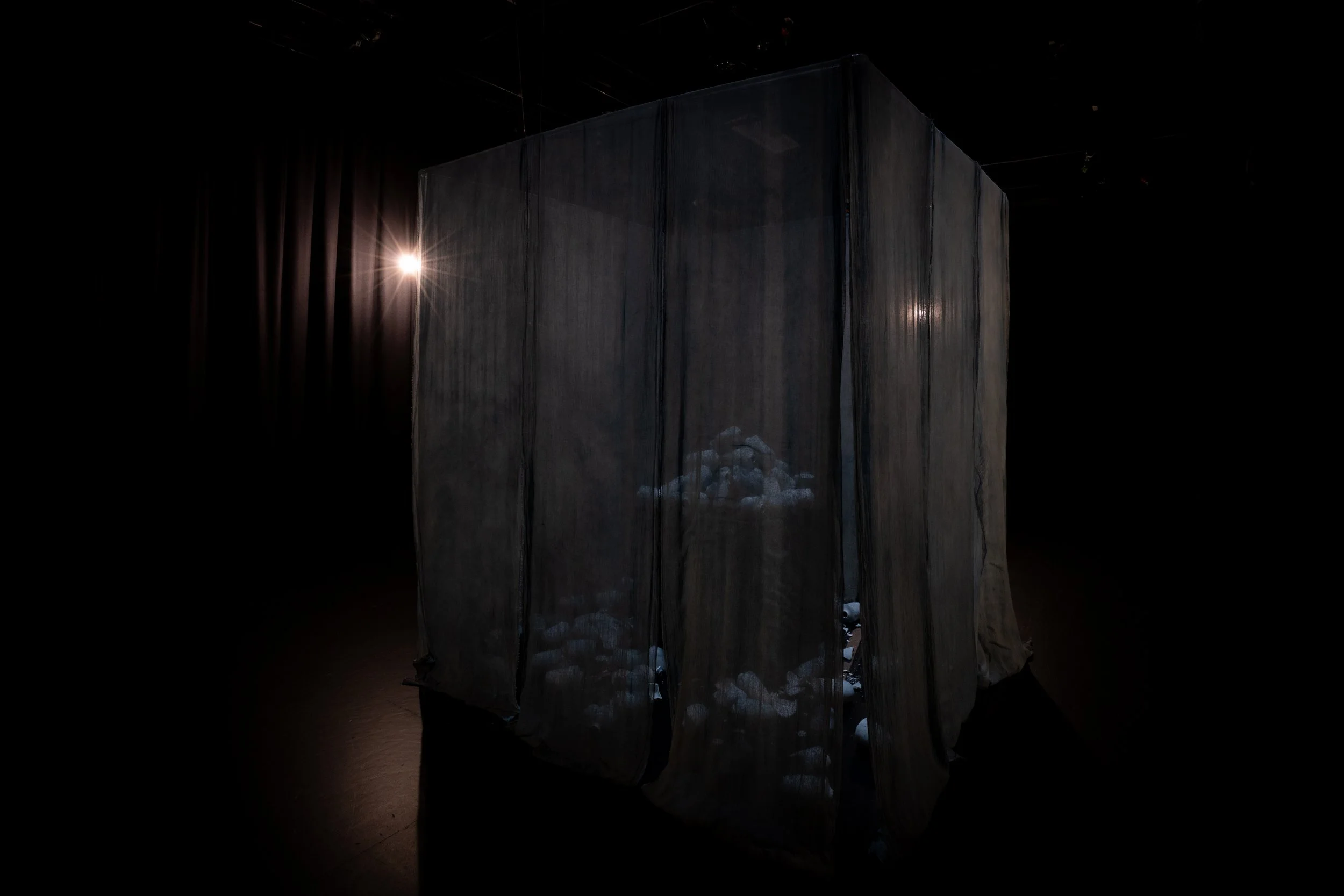
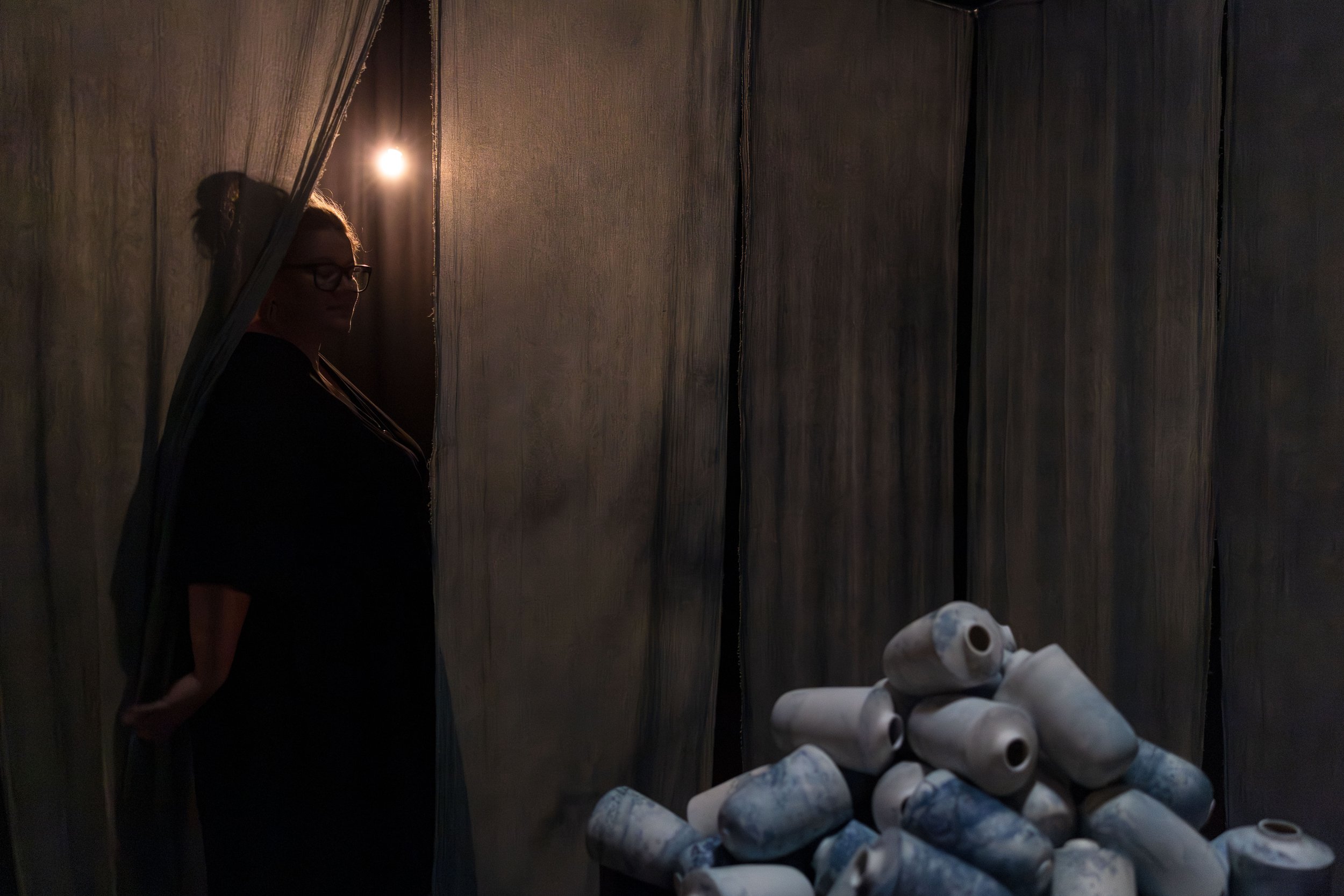
Rachel North’s sculptural installation the cairn exhibits a defining moment in the artist’s work to date. In this newest exploration, shape, colour, texture, space, and lighting are even more thoughtfully choreographed then before; a greater leap into intuitive, overall experimentation is established. Additionally, the cairn’s material and spatial articulations of subject and affect are deepened and intensified by North’s increased willingness to take chances and trust her creative decisions. The artist has constructed a phenomenological encounter (for both herself and the viewer), clearly embodying the tensions, barriers, and ruptures characteristic of grief and mourning. She continues to focus on the materiality of landscape, and how memory is inseparable from the land. However, with the cairn, interactions of matter and meaning present a more distilled discourse on how places, things, feelings, and people are entangled and intersubjective.
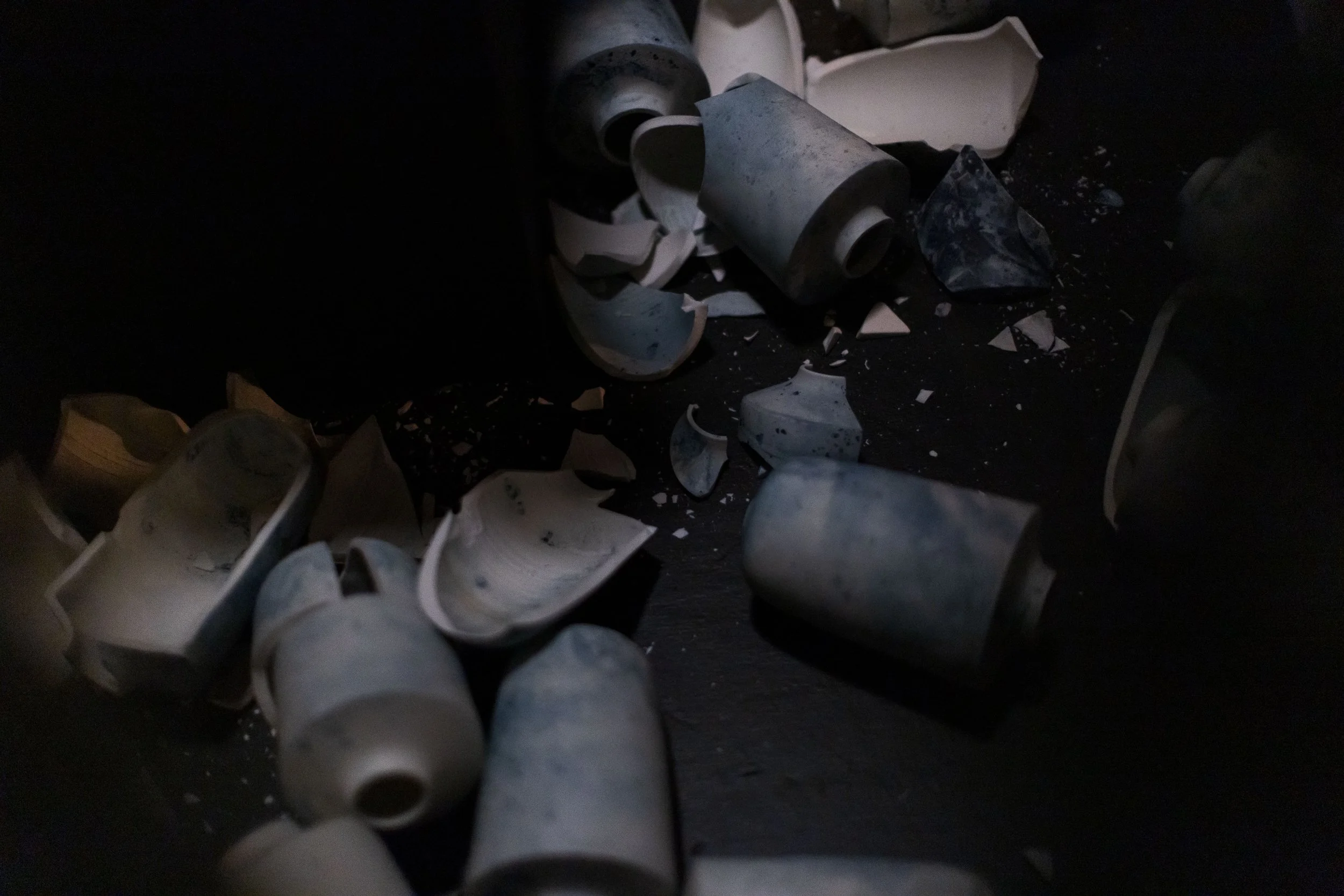
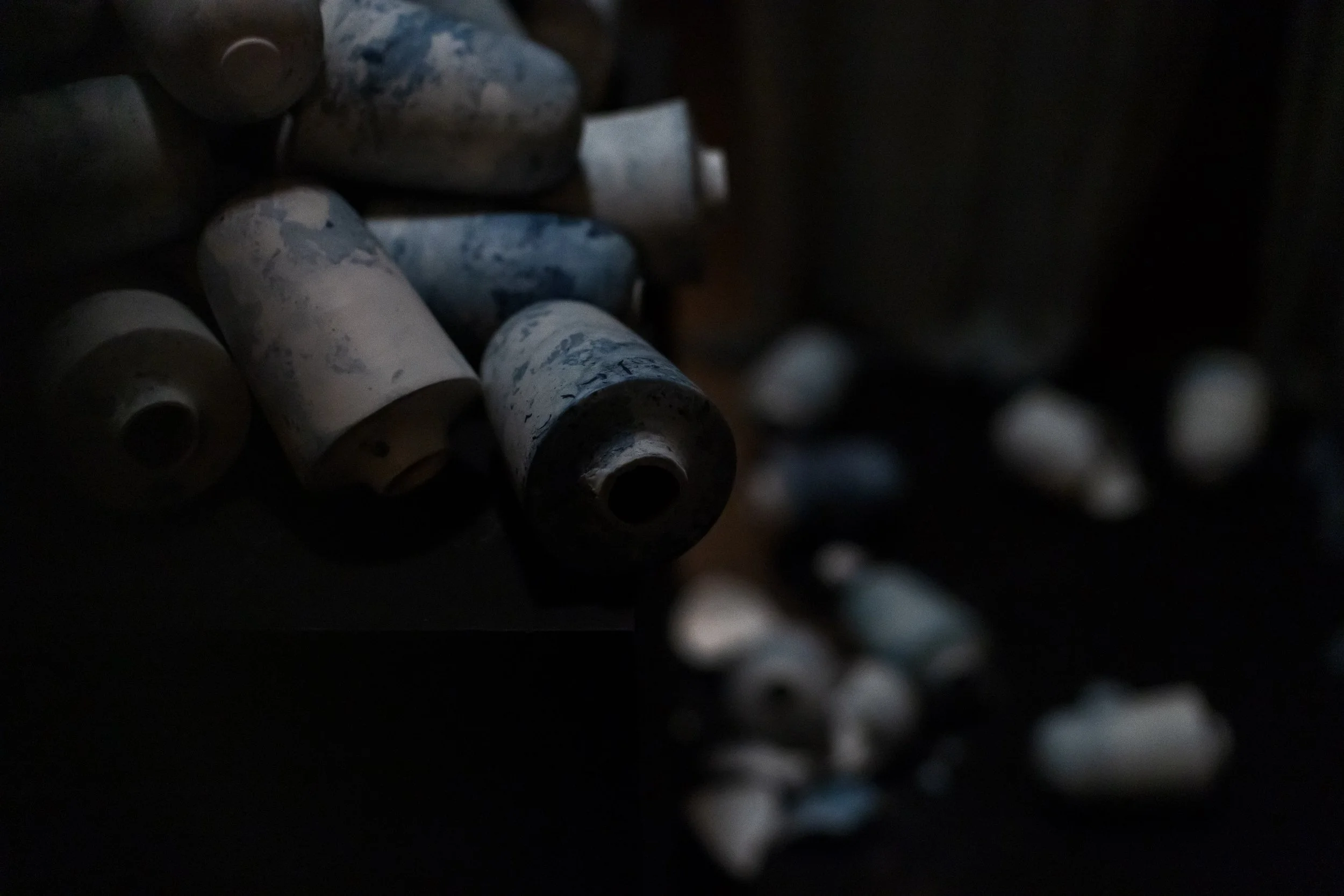
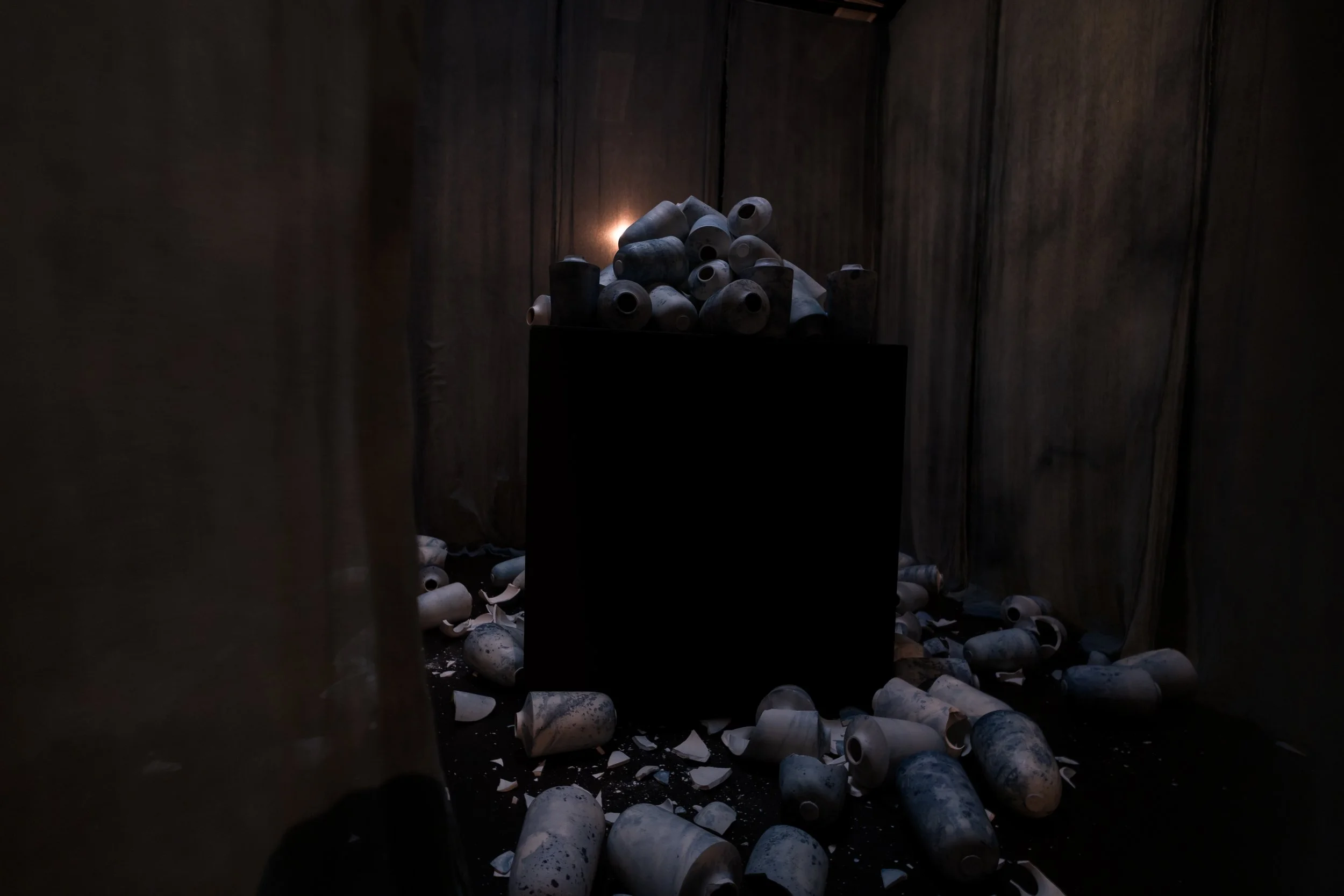
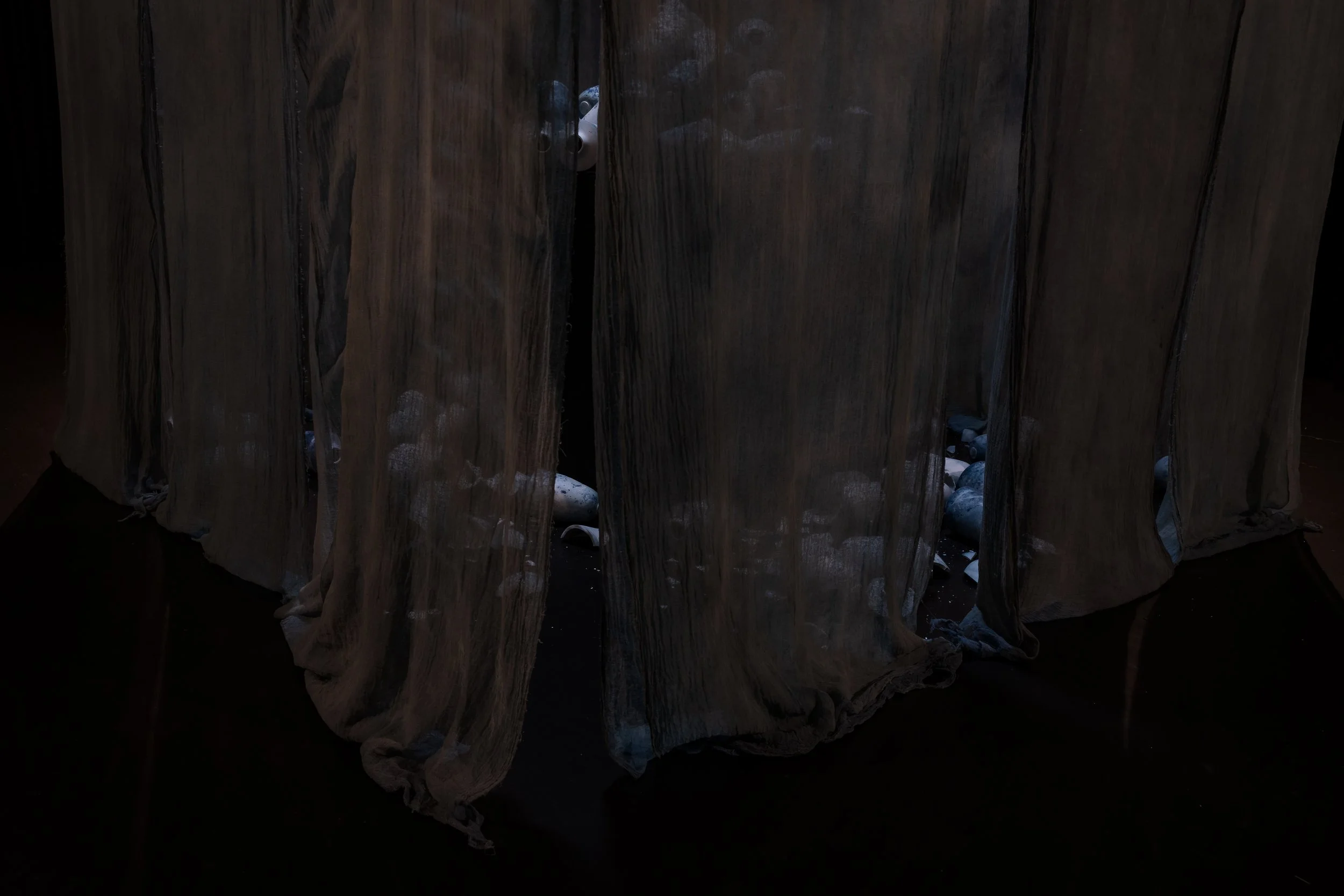
Upon entering the darkened exhibition space, a viewer sees in the near distance a three-dimensional enclosure formed by vertical veils of deep-blue cotton gauze, hanging from horizontal supports, with all four walls suspended from the ceiling. The resulting soft, rectangular architecture and the mystery of what’s inside beckon the viewer closer, into intimate dialogue with this proffered, fluid space. Traversing the room, and from a nearer stance, glimpses of unglazed, porcelain urns piled onto a plinth within the enclosure are seen through breaks in the fabric. The indigo-dyed gauze’s transparency creates a ghostly scrim; the porcelain glows ethereally; the overall effect is other-worldly and subdued. Diffused lighting, and North’s application of gestural, deep-blue indigo on the urns’ surfaces imply potential transformation. Because the vessels are partially obscured by the gauze, a simultaneous revelation and withholding reminiscent of a sacred space occurs. Scattered on the floor around the plinth, shards of fallen urns attest to an event that has happened here. In a manner in contrast with a traditional cairn’s immutable, controlled gravity, the cairn points to reshaping and rebuilding. Yet full of gravitas and sadness, North’s tableau of intact and broken funerary urns speaks to the intractable nature of grief, and to changes wrought by chance and change with the passage of time. Thus, the cairn is a monument to stages of grief and loss, as well as tangible evidence of temporality and durational aesthetics.
In the cairn, every urn is one tenth the artist’s height; each is, essentially, “a representation of [my]self.”1While assembling the cairn, North began stacking hundreds of hand thrown urns into a pyramid form. While she was doing so, they began to destabilise and move. Intuitively, she gave in to gravity, and let them topple as they would: grief is messy, and not a thing to be controlled. The finicky, fragile nature of porcelain and the impermanence of natural indigo dye attest to the precarity and transience of affective experience, attachment to place, and to unspoken losses of wholeness and unity. She has said that future iterations of the cairn will re-use existing pots and shards, and that she would add and break more urns, thereby making the installation larger, evolving – further pushing its performative impact.
Previously, with her large-scale installation memory’s shroud (2025) North used earth materials and colours to signify her memories, love, and bereavement for the rural landscapes on which she spent her childhood. memory’s shroud presents over seventy stoneware and porcelain vessels varying in clay body, size, application of texture, glaze, and firing atmosphere. As viewers, we intuitively recognise each vessel as a figurative abstraction of the memories that follow along with the artist. Perhaps the shroud to which the title refers is materially substantiated in the opacity and concrescence of the clay and glazes of each of the vessels. A shroud (like a memory) can obscure, disguise, protect, or conceal. 2
The cairn, like all North’s work, can be understood as a sort of autoethnography, that is, a research methodology, “that describes and systematically analyses one’s experiences to understand them in relation to their context.”3 However much this installation turns inward, grounding itself in personal narrative, North is always looking to expand her awareness of viewers’ responses. Universal rituals, beliefs, and ideas surrounding death, memory, landscape, and loss are of keen interest to her. But she has been drawn to these concerns by working through her own survival in the face of trauma. Seeking to understand drives her ongoing inquiry, self-expression, and articulation.
North names influences such as Japanese artist Chiara Shiota as vital to her own development. However, Shiota’s monumental installations emanate an almost corporate cleanliness, as opposed to North’s works’ bold, and vulnerable earthiness. The sculptor Louise Bourgeois also comes to mind because of her emphasis on material instability, psychic interiority, and eccentric, architectural structuring of emotional states. Ultimately, the cairn operates as a dynamic personal monument: durational, cyclical, and effectively in continual transformation. Each future iteration – composed of new vessels, new breakages, new spatial arrangements – would re-enact the potent, fluid nature of grief, re-affirming the cairn as a living, evolving configuration of remembrance.
The original 2025 installation of the artwork the cairn was produced and documented with the support of grant monies distributed by the Regional Arts Development Fund.
The Regional Arts Development Fund is a partnership between the Queensland Government and Ipswich City Council to support local arts and culture in regional Queensland.

Personal communication with the artist, 19 November 2025.
https://www.merriam-webster.com/dictionary/shroud.
https://researchmethodscommunity.sagepub.com/blog/when-you-are-the-participant-collecting-autoethnographic-data.